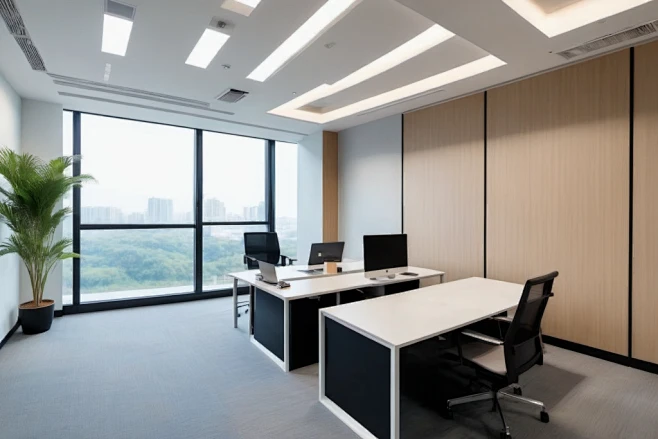
Most people assume low productivity or constant exhaustion at work comes from heavy tasks, endless meetings, or noisy coworkers.
But after assessing countless workplaces, I’ve found a different pattern—one that surprises many people: The more a company upgrades its tools, the more tired people become. The problem is not the workload. It’s that the entire office structure is working against the people inside it. Practical feng shui in an office is not about placing symbolic items or adding lucky plants. It is about rearranging the core structure of the space so people work with the flow of the environment, not against it. In classical Feng Shui, this fundamental system is known as the Three Essentials of a Yang House: Door · Master · Position. In a modern office, they correspond to: where energy enters, where authority sits, and whether each role is placed in the right zone. This principle becomes especially clear when analyzing how feng shui in an office influences daily workflow.
Door · Master · Position — The Three Essentials in an Office
1. The Door — The “Qi Entrance” That Determines What Your Office Receives Each Day
A door is not just an opening. It defines how pressure, opportunity, clients, and information enter your company. One of the most common issues I see is the presence of 冲煞 (rush-sha)—a direct, forceful line of movement hitting a sensitive location: the reception desk sits directly in line with the front door; a manager’s seat is at the end of a long corridor; employee desks are placed along a straight path where people constantly pass behind them. This kind of linear impact is one of the strongest negative forces in office Feng Shui. It’s not superstition—your body naturally enters a defensive state: harder to relax, decision-making becomes unstable, heart rate subtly increases, fatigue arrives faster. These reactions are frequently observed when feng shui in an office is not properly considered.
Break up the straight line with a gentle turn in the walkway.
Use plants, a low cabinet, or a reception buffer to slow the incoming flow.
Avoid placing key roles directly on the path of incoming movement.
When the door is “aligned,” the office no longer receives pressure head-on— instead, it receives energy at a manageable pace. This shift alone often becomes the first visible improvement when applying feng shui in an office.
2. The Master Position — Whoever Sits Here Carries the Weight of the Entire Space
Teams often look chaotic not because of people, but because the master position was never established properly. A real example: in a tech company I assessed, the CEO’s desk was placed beside the pantry, with heavy foot traffic behind him. Meanwhile, someone in a minor role was seated in the most stable and commanding spot in the entire office. The results were predictable: the CEO was interrupted ten times an hour; managers kept taking on tasks that weren’t theirs; the team subconsciously “searched” for a center of authority, but the physical space provided none. Situations like this illustrate why feng shui in an office is directly connected to leadership stability.
More dangerous is 梁煞 (beam-sha)—a beam directly above the master seat. Even without noticing it, the body reacts: slower judgment, irritability, rising tension in meetings, increased conflict. In many consultations, this beam pressure becomes the fastest way to identify misalignment in feng shui in an office.
The back must be protected—never sit with your back to the door or a busy corridor.
Avoid sitting directly under a beam; let the beam press on furniture, not on people.
Ensure the main decision-maker sits in a position the room naturally supports, not one the room disturbs.
Once the master position is stabilized, the entire organization gains a center. This alignment is one of the core outcomes expected when adjusting feng shui in an office.
3. Placement — When Each Role Sits in the Right Zone, Efficiency Rises Naturally
Placement answers three questions: who should be in a quiet zone? Who should be in an active zone? Who should sit in a “mountain” position and who should sit in a “facing” position? In Feng Shui, we divide office space into two functional types:
Best for: strategy, research, writing, deep work, analysis
Best for: customer service, collaboration, sales, reception, BD
Many modern office problems come from “role-position mismatch”: a writer or analyst sits near the door or pantry—concentration shatters all day; a communication-heavy role is placed in the deepest, quietest part of the office; a meeting room sits in the busiest flow, making every discussion unfocused. This is called “mountain and facing reversed.” Fixing placement is simple: move deep-work roles toward the “mountain” side (inner, quieter, away from corridors); place communication-based roles in more active zones (near doors, flow, openness); let every role function in an environment that matches its nature. Once mountain and facing return to balance, team rhythm visibly improves. This balance is one of the clearest indicators that feng shui in an office is functioning correctly.
Two Feng Shui Patterns That Make You “More Tired the More You Work”
1. Rush-Sha (冲煞) — door facing, corridor impact, back-exposed seating
Signs: Back facing a walkway, desk at the end of a straight line, constant movement behind you.
Effects: Unease, hyper-alertness, fragmented attention.
Solutions: Shift seat angle, add buffers, soften straight lines. These corrections form the foundational steps when implementing feng shui in an office.
2. Beam-Sha (梁煞) — beams pressing above key seats
Signs: Beams above managers, meeting tables, or main work zones.
Effects: Tension, irritability, slower judgment.
Solutions: Move the seat, visually reduce beam presence, let it press on objects not people. Without addressing beam pressure, feng shui in an office cannot operate effectively.
Removing these two alone often brings immediate clarity and stability to the team. In many cases, these are the exact elements that block the natural flow of feng shui in an office.
What You’re Really Adjusting When You Work with Feng Shui in an Office
Professional office Feng Shui is not decoration. It is a structural strategy: read the door: where does energy enter? Is there impact? Establish the master seat: who needs the room’s support? Correct mountain and facing: is the zoning reversed? Assign roles to zones: who belongs where? Dissolve negative forms: rush-sha, beam-sha, and more. Fine-tune with small layout adjustments. It’s a system of space → people → workflow, not mysticism. Understanding these layers reveals why feng shui in an office produces measurable changes in performance.
If You Suspect Your Office Is “Draining You,” It’s Time for a Professional Assessment
If you want: a master seat that reinforces leadership, a mountain zone where deep work can finally settle, a layout that doesn’t scatter attention, a workspace where efficiency rises naturally, you can learn more about my consultation process here:
office feng shui consultationClients rarely say, “We got lucky.” They usually say: “We finally stopped firefighting and started moving forward again.” Good Feng Shui isn’t about superstition. It’s about placing people where the space supports them— so effort has momentum, and work finally flows. Ultimately, this is the purpose of feng shui in an office: restoring alignment between space, people, and performance.