
Feng Shui Origin
Feng shui is often presented as if it appeared fully formed — an ancient Chinese wisdom with complete rules for every spatial situation. The reality is more interesting. Feng shui origin is not a single moment Feng shui origin is not a single moment of revelation but a two-thousand-year accumulation of observation. Understanding the feng shui origin story explains why different schools sometimes give different recommendations. of revelation but
The Practical Beginning: Site Selection (Form School)
The earliest feng shui meaning was entirely practical — site selection for shelter and water access. These principles of feng shui developed from survival needs into a systematic practice. Before there were compasses and Bagua maps and Flying Star calculations, there was a farmer deciding where to build. Does this site have shelter from the wind? (Hence 风, wind.) Does it have access to water? (Hence 水, water.) Is it safe from flooding? Does it get winter sun? These are not mystical questions. They are survival questions that every human settlement throughout history has had to answer.
The Form School (形峦, Xing Luan) of feng shui developed from these practical observations into a systematic method for evaluating landforms. The ideal site had mountain support behind (靠山, kao shan — literally "leaning mountain"), open space in front (明堂, ming tang — "bright hall"), protective arms on both sides (青龙白虎, Qing Long Bai Hu — "Azure Dragon White Tiger"), and water flowing gently past (水口, shui kou — "water mouth"). These principles of feng shui describe real physical features that affect how a site feels. These principles of feng shui describe real physical features that affect how a site feels. The feng shui origin in practical observation is why form assessment remains the foundation of all chinese feng shui practice. that affect how a site feels and functions: wind protection, sun exposure, flood safety, and access to water.
Form School remains the foundation of all chinese feng shui practice because the external environment (外局, wai ju) is always evaluated first. No amount of internal arrangement can compensate for a house located at the base of a cliff (no mountain support, risk of falling objects) or at the end of a T-junction (sha qi rushing directly at the front door). The form principles are the least mystical and most universally applicable part of feng shui — which is why they developed first and remain primary.
The Systematization: Compass School and the Bagua
Around the Song Dynasty (960-1279 CE), feng shui incorporated the Yijing (易经, Book of Changes) and the Bagua (八卦, Eight Trigrams) into its framework. This marked the development of the Compass School (理气, Li Qi — literally "principle and qi"), which added directional calculations to the form-based assessments. The compass — eventually developed into the luopan (罗盘) with its multiple concentric rings — became the primary instrument.
The Compass School introduced the idea that not only the physical forms matter, but also the directional alignment — which way the house faces relative to compass directions, and how those directions interact with the time period of construction. This is the origin of the feng shui meaning that most people encounter today: the Bagua overlay, the eight sectors with life-area correspondences, and the Five Element relationships between directions and rooms.
The development of the Compass School also explains why there are competing systems within feng shui. The Eight Mansions (八宅, Ba Zhai) system, which uses Kua numbers and personal directions, developed alongside the Flying Star (玄空, Xuan Kong) system, which uses time-sensitive star charts. Both are "real" feng shui. They represent different layers of analysis that developed at different times and emphasize different variables — personal compatibility in Eight Mansions, time-sensitive energy in Flying Star.
Modern Application: From Villages to Apartments
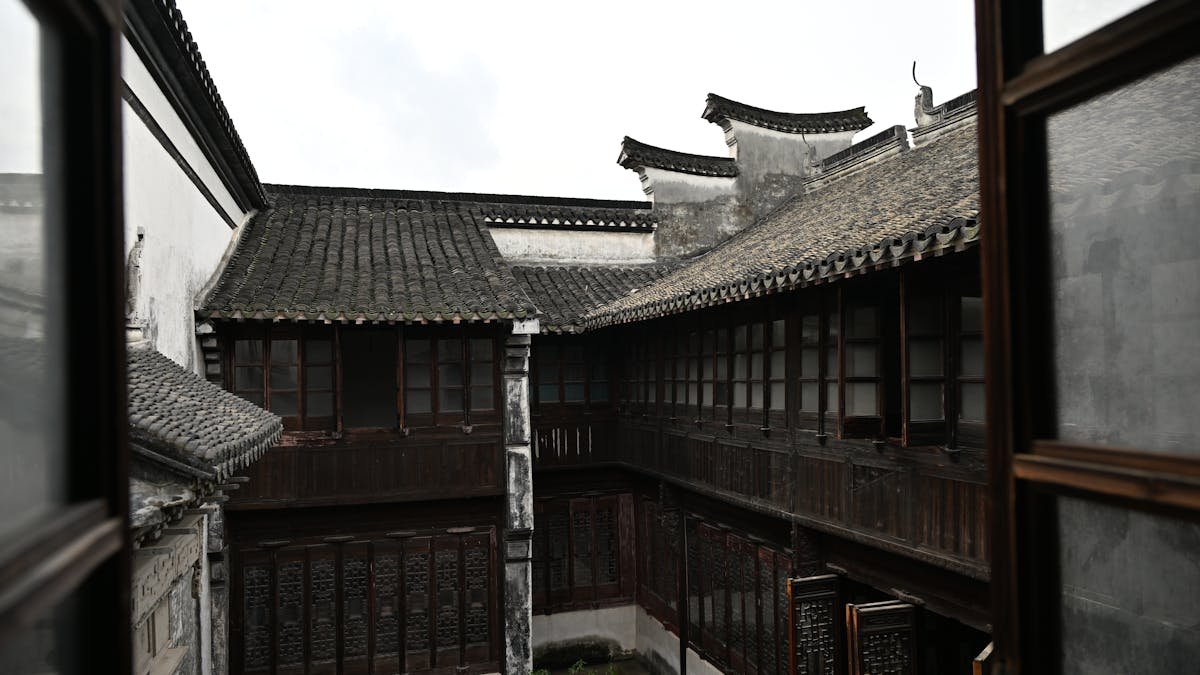
The modern feng shui origin question includes a practical dimension: did feng shui develop for a type of architecture that no longer exists? The answer is yes — classical feng shui was developed for courtyard houses (siheyuan), single-story structures with clear front-back orientation, and village-scale site selection. Modern apartments, high-rises, and open-plan layouts present challenges that classical texts did not anticipate.
The adaptation is not as difficult as it might seem. The principles — mountain support (a solid wall, a higher building behind), bright hall (open space in front, an unobstructed view), water flow (circulation paths through the space) — transfer to modern architecture because they describe spatial relationships, not specific building materials. A high-rise apartment still has a facing direction, a front door, and a qi circulation path. The chinese feng shui vocabulary changes; the spatial principles persist. The feng shui origin in practical site selection explains why form assessment remains the first step in any professional chinese feng shui evaluation. The what is feng shui answer is rooted in this origin: a spatial practice developed for courtyard houses that adapts its principles to modern apartments without losing its foundation.
What modern application requires is judgment about which classical rules transfer directly and which need adaptation. A classical text specifying that the kitchen should be in the east wing of a courtyard house doesn't translate literally to an apartment where the kitchen is fixed by the builder. The principle — kitchen in a Wood sector where the Fire of cooking is productively supported — transfers. The specific architectural form — a separate east wing — does not.
FAQ
The feng shui origin traces back over 2,000 years to the Han Dynasty (206 BCE-220 CE) for the earliest systematic texts on site selection. The Form School principles are the oldest layer. The Compass School developed significantly during the Song Dynasty (960-1279 CE), making it roughly 1,000 years old. Flying Star calculations reached their current form during the Qing Dynasty (1644-1912 CE).
Feng shui shares conceptual foundations with Daoism — qi, yin-yang, the Five Elements, the Bagua — but it is a practice, not a religious doctrine. You do not need to be Daoist to practice feng shui, just as you do not need to be Greek to use geometry. The what is feng shui answer: it is a traditional Chinese spatial practice with Daoist conceptual roots.
Because different historical periods emphasized different variables. Form School came first — physical landforms. Compass School added direction. Eight Mansions added personal compatibility. Flying Star added time. Each addition addressed a variable the previous system didn't fully account for. The schools coexist because they address different layers of a complete assessment.
Yes and no. The principles are the same. The application to modern architecture requires adaptation — your apartment building's elevator shaft and stairwell are circulation features that classical texts didn't discuss because they didn't have elevators. But the principle — vertical shafts accelerate qi — transfers. Good chinese feng shui practice adapts principles to modern forms without abandoning the principles.
Next Step
Feng shui's origin is in practical observation of how spaces affect people. Its modern application continues that tradition — adapted to contemporary architecture but grounded in the same spatial principles.
Book a Home Feng Shui Consultation*A consultation applies traditional feng shui principles to your modern space — respecting the origin while adapting to the reality of contemporary architecture.*
Get a professional assessment that applies these principles to your specific space — not generic advice.
A Home Feng Shui Consultation evaluates your home's structure, orientation, Bagua overlay, and room-by-room energy distribution. Specific recommendations based on your actual floor plan.
- Complete floor plan analysis with Bagua overlay and Flying Star chart
- Room-by-room recommendations based on compass sectors and personal Kua directions
- Structural, furniture, element, and annual adjustment plan — all four layers